Showing posts with label eBook. Show all posts

Friday, June 8, 2018

Chemical Engineering: Trends and Developments By Miguel A. Galan [eBook] [PDF]


by Miguel A. Galan, Eva Martin del Valle
English | 2005 | ISBN: 0470024984 | 400 Pages | PDF | 9.02 MB

From the Back Cover

Chemical engineering is being revolutionised by the emergence of innovative applications, developing into a process technology that affects many difference industries. Significant advances in techniques have developed in four key areas: bioseparations, nanotechnology, particle science and design, and reaction engineering. This book provides an overview of the main areas of technical development and their applications.

Chemical Engineering: Trends and Developments begins with the scope and basic concepts of chemical engineering by explaining the advances in chemical engineering and the rationale for the selected topics. This book continues with an overview of the whole discipline with several chapters related to the separations process. Subsequent chapters focus on applications covered in the field, such as reaction engineering, particle manufacture and encapsulation and coating. The final chapters are dedicated to process integration with techniques applied to actual industry practice, demonstrating the advances and opportunities in this field.

Key features:
- Focuses on the key technical advances in the areas of bioseparations, nanotechnology, particle science and design, and reaction engineering.
- Each chapter focuses on a specific topic, providing detailed prospective on technical innovations and industrial applications.
- A broad coverage enables readers from different disciplines to adopt new techniques for their working practices.

Download: https://bittfox.com/3nw/Chemical_Engineering_Trends_and_Developments.pdf

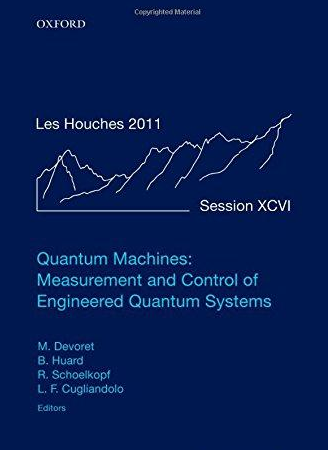
Quantum Machines: Measurement and Control of Engineered Quantum Systems [eBook] [PDF]


2014 | 608 Pages | ISBN: 019968118X | PDF | 14 MB

This book gathers the lecture notes of courses given at the 2011 summer school in theoretical physics in Les Houches, France, Session XCVI.

What is a quantum machine? Can we say that lasers and transistors are quantum machines? After all, physicists advertise these devices as the two main spin-offs of the understanding of quantum mechanical phenomena. However, while quantum mechanics must be used to predict the wavelength of a laser and the operation voltage of a transistor, it does not intervene at the level of the signals processed by these systems. Signals involve macroscopic collective variables like voltages and currents in a circuit or the amplitude of the oscillating electric field in an electromagnetic cavity resonator. In a true quantum machine, the signal collective variables, which both inform the outside on the state of the machine and receive controlling instructions, must themselves be treated as quantum operators, just as the position of the electron in a hydrogen atom. Quantum superconducting circuits, quantum dots, and quantum nanomechanical resonators satisfy the definition of quantum machines. These mesoscopic systems exhibit a few collective dynamical variables, whose fluctuations are well in the quantum regime and whose measurement is essentially limited in precision by the Heisenberg uncertainty principle. Other engineered quantum systems based on natural, rather than artificial degrees of freedom can also qualify as quantum machines: trapped ions, single Rydberg atoms in superconducting cavities, and lattices of ultracold atoms. This book provides the basic knowledge needed to understand and investigate the physics of these novel systems.

Download: https://bittfox.com/3nu/Quantum_Machines_Measurement_and_Control_of_Engineered_Quantum_Systems.pdf

God and the Atom By Victor J. Stenger [eBook] [ePUB]


English | ISBN: 1616147539 | 2013 | EPUB | 300 Pages | 2,7 MB

This history of atomism, from Democritus to the recent discovery of the Higgs boson, chronicles one of the most successful scientific hypotheses ever devised, making the case that in the final analysis, atoms and the void are all that exists. Originating separately in both ancient Greece and India, the concept of the atom persisted for centuries, despite often running afoul of conventional thinking. Until the twentieth century, no direct evidence for atoms existed. Today it is possible to actually observe atoms using a scanning tunneling microscope. The book begins with the story of the earliest atomists - the ancient Greek philosophers Leucippus, Democritus, and Epicurus, and the Latin poet Lucretius. As the author notes, the idea of elementary particles as the foundation of reality had many opponents throughout history - from Aristotle to Christian theologians and even some nineteenth-century chemists and philosophers. While theists today accept that the evidence for the atomic theory of matter is overwhelming, they reject the atheistic implications of that theory.

Download: https://bittfox.com/3nr/God_and_the_Atom.epub

New Electronics - November 10, 2015


English | PDF | 44 pages | 11 MB

Download: https://bittfox.com/3np/NewElectronics_1011_2015.pdf

Open House Foodservice - October 2015


English | PDF | 40 pages | 10 MB

Download: https://bittfox.com/3nn/OpenHouseFood_102015.pdf